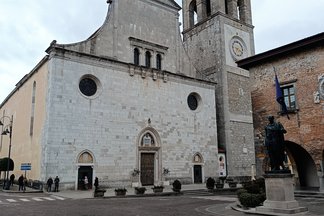
Lombard temple


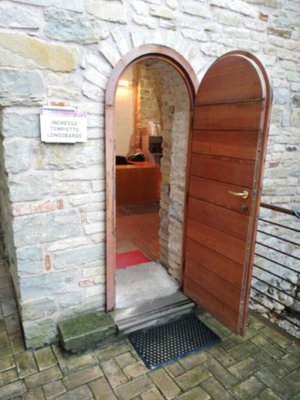
The Tempietto represents an extraordinary testimony to early medieval architecture. Not only should the name "Lombard Tempietto" be interpreted more as a temporal indication, i.e. built in the Lombard era, but the origin of the workers who worked on it and its actual original purpose are still unclear.
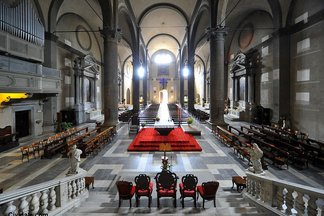
Rising in the mid-8th century AD, it was probably originally the palatine chapel within the gastaldaga. Later it became oratory of the Benedictine women's convent, enlarged by King Berengar's 10th-century donation. From the 18th century it became the capitular hall of the convent, and finally, in the last years of the 19th century, donated to the community of Cividale. The present entrance is from the 'original presbytery: originally the walls were adorned with a series of marble slabs that reached a certain height, beyond which the frescoes and especially the delicate and magnificent stucco decorations, arches decorated with vine shoots and higher up the hieratic figures of the saints, played with the light. Iridescent reflections, related to the passing of the hours and different light conditions, were also supposed to reverberate in the glass pastes set in the center of the stylized flowers at the feet of the saints. Classical models and Longobard decorative solutions (the interwoven motifs) coexist with the Byzantine touch, creating a unicum that has landed the Tempietto, and Cividale as a whole, on the list of Unesco properties:" The Longobards in Italy. Places of Power." To a much later period, towards the end of the 14th century, belong the splendid wooden stalls that made up the nuns' choir. Articulated in a double order: the main one with a high back, decorated and carved; the lower one, simpler and intended for the novices, consisting of simple seats. In particular, the stalls that can be identified to the right of the original entrance to the Tempietto, are the largest and preciously enriched with coats of arms: they were the seats of the Abbess and the Regent, in a clear order of hierarchical superiority. Many essences are used: larch, walnut, poplar , chestnut.
Accessibility
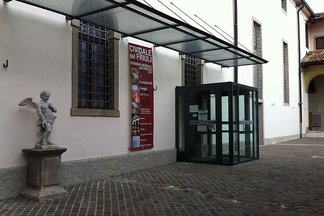
The tour is on several floors, the facility does not have an elevator, for the visually impaired there are plastic representations of the complex, immersive room for people with cognitive difficulties, accessible by elevator. Audio guides in multilingual are provided. Videos showing the history of the Lombard Temple and the Lombards, duration of each video in total 3 from minimum 3 minutes to 10 minutes.
For more detailed information look at the "temple" section.
Altri posti da visitare